

From Google Ads to referral programs, here are the HVAC marketing ideas that actually fill your dispatch board — backed by real contractor data.
★ The Fast Facts
- 97% of consumers search online before hiring a local service contractor (BrightLocal, 2024)
- HVAC companies using Google Local Services Ads report an average cost-per-lead of $20–$60
- Email marketing delivers an average ROI of $36 for every $1 spent across service industries
- Businesses with 50+ Google reviews earn 2.7x more clicks than those with fewer than 10
- HVAC companies that blog consistently generate 55% more website traffic than those that don’t
Reviewed and fact-checked by Radiarc marketing experts.
In this article
- Why Most HVAC Marketing Ideas Fail (And What Actually Works)
- Your HVAC Marketing Foundation: Website, SEO, and Google Maps
- Paid Advertising Ideas That Generate Fast HVAC Leads
- Social Media and Content Marketing for HVAC Contractors
- Reputation Management and Referral Programs
- Seasonal and Local Marketing Tactics That Fill Slow Months
- Building a Long-Term HVAC Marketing System
Why Most HVAC Marketing Ideas Fail (And What Actually Works)
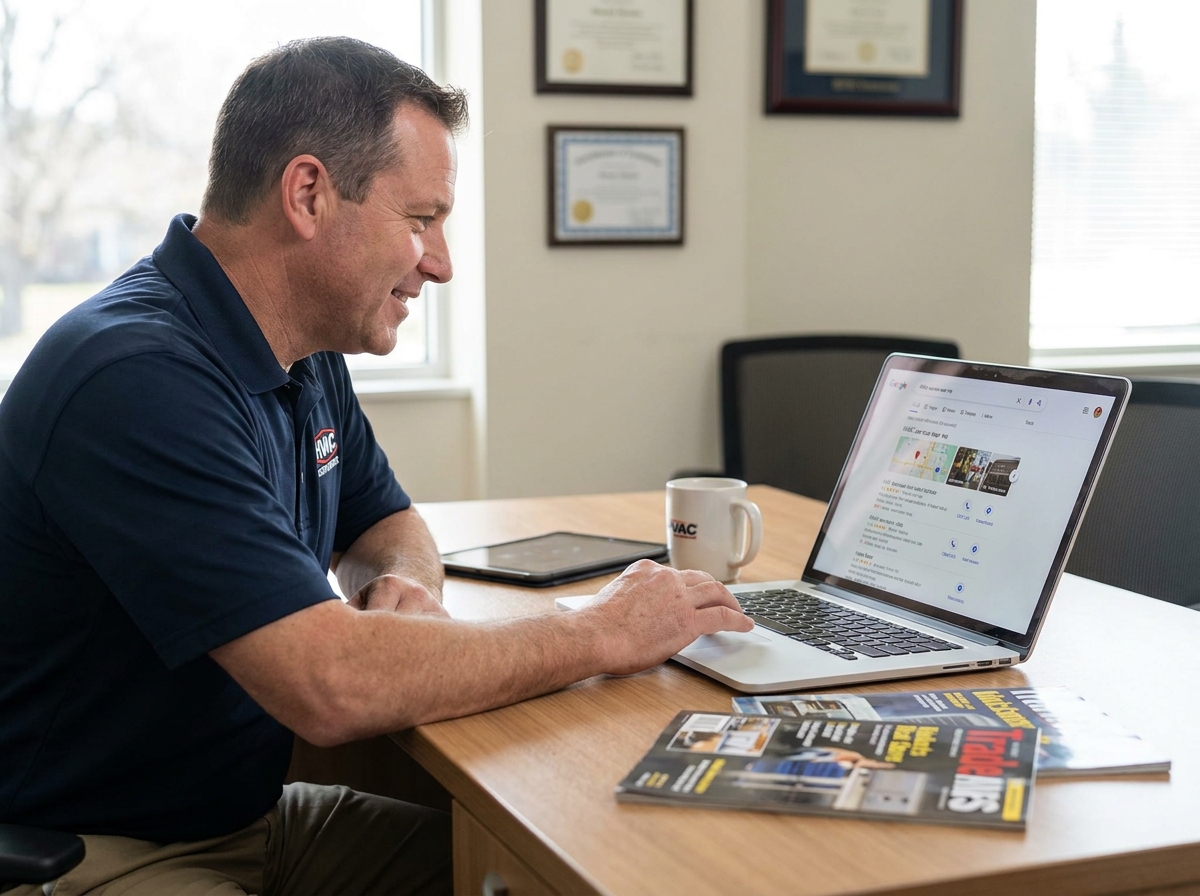
Every HVAC contractor has tried at least one marketing idea that didn’t pan out. Maybe it was a Yelp ad that generated zero calls, a Facebook campaign that burned through $500 without a single booked job, or a postcard mailer that disappeared into the recycling bin. You’re not alone — and the problem usually isn’t the tactic itself. It’s applying tactics without a strategy.
The HVAC industry is uniquely challenging to market. Your customers don’t think about you until something breaks — and when it does, they’re searching on their phone in a panic, ready to hire the first trustworthy company that shows up. That single behavior pattern should reshape how you think about every marketing dollar you spend.
Effective HVAC marketing ideas share three things in common:
- They show up when intent is highest. The homeowner with a broken AC in July is not browsing social media looking for HVAC companies. They’re Googling “AC repair near me” or asking their neighbor for a referral. Your marketing needs to be there at that exact moment.
- They build trust before the phone rings. Reviews, photos of real work, a professional website, and a visible local presence all do the job of convincing someone to call you over a competitor before they’ve ever spoken to you.
- They compound over time. The best HVAC marketing investments — like local SEO, a strong review profile, and a healthy email list — keep paying dividends long after you make them.
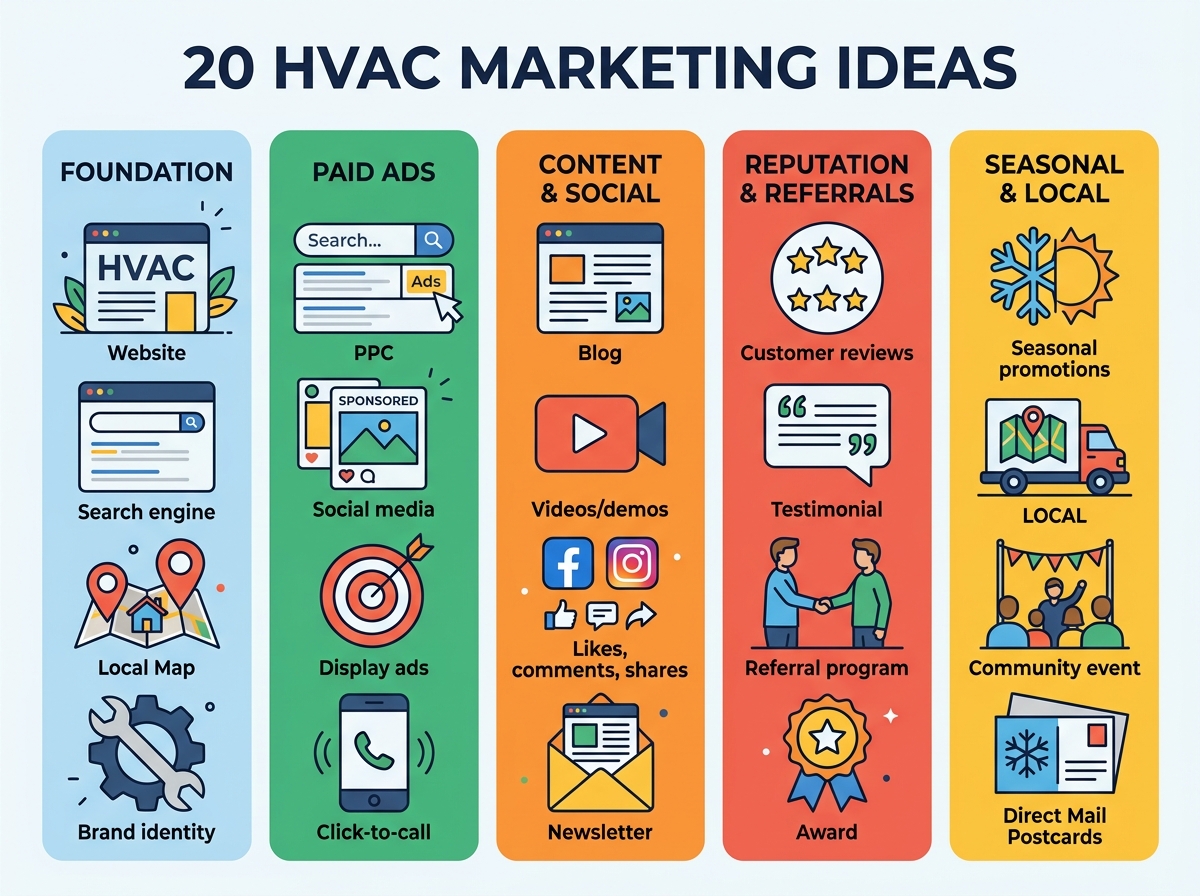
This guide covers 20 specific, actionable HVAC marketing ideas organized by channel. We’ll tell you which ones drive fast results, which ones build long-term equity, and how to prioritize them based on your budget and business goals. Whether you run a two-truck operation or manage a crew of 20 technicians, there’s a path here for you.
Your HVAC Marketing Foundation: Website, SEO, and Google Maps
Before you run a single ad or post on social media, your foundation has to be solid. Think of your website, local SEO, and Google Business Profile as the storefront that all your other marketing drives traffic to. If those three things are weak, every other tactic you run is pouring water into a leaky bucket.
1. Build a Website That Converts, Not Just One That Looks Nice
Your website has one job: turn visitors into phone calls or form submissions. A surprising number of HVAC websites fail at this completely. They have no clear call-to-action above the fold, phone numbers buried in the footer, and service pages so thin that Google ignores them entirely.
A high-converting HVAC website includes:
- A click-to-call phone number in the top right corner on every page
- A clear headline that states what you do and what city/region you serve
- Trust signals near the top: years in business, number of reviews, licenses, and certifications
- Dedicated service pages for every major offering (AC repair, furnace installation, heat pump service, etc.)
- Dedicated location pages if you serve multiple cities or towns
- A simple contact form that takes less than 60 seconds to fill out
- Page load speed under 3 seconds — Google’s Core Web Vitals directly affect your ranking
2. Dominate Local SEO for High-Intent Keywords
Local SEO is the process of optimizing your online presence so you rank at the top of Google when someone nearby searches for HVAC services. For most HVAC contractors, this is the single highest-ROI marketing channel available — but it takes 3–9 months to build serious momentum.
The most important local SEO actions for HVAC companies include:
- Optimizing your Google Business Profile with complete service listings, photos, and regular posts
- Building city-specific service pages (e.g., “AC Repair in [City Name]”)
- Earning citations (consistent business name, address, phone) on directories like Yelp, Angi, and HomeAdvisor
- Publishing regular blog content targeting long-tail keywords your customers search
- Getting inbound links from local organizations, chambers of commerce, and industry associations
3. Optimize Your Google Business Profile Weekly
Your Google Business Profile (GBP) is essentially free real estate on the most valuable piece of digital property in local search: the Google Maps 3-pack. Companies that appear in those top three map results often capture 40–60% of all local clicks for a given search.
Post weekly updates, upload before-and-after job photos regularly, respond to every review (positive and negative), and make sure your service area, hours, and service categories are fully filled out. This consistency signals activity and authority to Google’s local ranking algorithm.
💡 Good to Know: Pro tip from HVAC contractors who rank #1 locally: The companies that dominate Google Maps typically have 3–5x more reviews than their nearest competitor AND upload fresh job photos at least twice per week. Volume and recency both matter to Google’s ranking algorithm.
46%
of all Google searches have local intent — meaning nearly half of all searches are looking for a nearby business or service
Paid Advertising Ideas That Generate Fast HVAC Leads
SEO is a long game. When you need the phone ringing next week, paid advertising is how you bridge the gap. The key is understanding which paid channels work best for HVAC and how to avoid the most common money-wasting mistakes. For a deeper dive into the full digital marketing ecosystem, check out Radiarc’s HVAC Digital Marketing Ultimate Guide — it covers the complete strategy for 2026.
4. Google Local Services Ads (LSAs): The Best Cost-Per-Lead in HVAC
Google Local Services Ads appear above everything else in search results — above regular Google Ads, above the map pack, above organic results. You only pay when a potential customer calls or messages you directly through the ad. For most HVAC markets, the cost per lead runs between $20 and $60, making it one of the most efficient paid channels available.
To run LSAs, you’ll need to pass Google’s background check process and earn the “Google Guaranteed” badge. Once active, your ranking within LSAs is influenced by your review count, review rating, and responsiveness to leads. Companies that answer calls quickly and maintain a 4.5+ star rating consistently rank at the top.
5. Google Search Ads (PPC): Fast Traffic for High-Value Keywords
Traditional Google Pay-Per-Click (PPC) ads let you target specific search terms like “emergency HVAC repair” or “furnace replacement cost.” You pay per click, not per lead, so conversion rate optimization matters enormously. A poorly built campaign can blow $2,000 per month and generate almost nothing.
The most important PPC best practices for HVAC contractors:
- Use exact match and phrase match keywords — avoid broad match, which burns budget on irrelevant searches
- Add aggressive negative keywords lists (e.g., “DIY,” “how to,” “parts,” “free”)
- Send ad traffic to dedicated landing pages, not your homepage
- Use call extensions and location extensions on every ad
- Run ads only during your business hours unless you have 24/7 answering
- Set geographic radius targeting to your actual service area — not broader
6. Meta Ads for HVAC: Awareness and Seasonal Promotion
Facebook and Instagram ads work differently than Google — your audience isn’t actively searching, so direct response works better for planned purchases and seasonal promotions than emergency repairs. Use Meta Ads to promote maintenance plan sign-ups, AC tune-up specials before summer, and heating system checkups before winter.
Retargeting is especially powerful here: serve ads specifically to people who visited your website in the last 30–60 days but didn’t convert. These warm audiences convert at 2–3x the rate of cold audiences and cost significantly less per click.
7. Nextdoor Ads: The Neighborhood Referral Engine
Nextdoor has become a surprisingly effective channel for HVAC contractors in residential markets. Homeowners trust recommendations from verified neighbors more than almost any other source. A combination of organic posts in neighborhood groups and paid Nextdoor Business ads can establish you as the go-to HVAC company block by block in your service area.
⚠️ Warning: Never send paid ad traffic to your homepage. Google’s algorithm and your conversion rate both suffer when there’s no clear alignment between the ad’s promise and the landing page. Build specific pages for “AC Repair,” “Furnace Installation,” and “Emergency HVAC Service” and route the relevant ads there.
Want a Paid Ad Strategy Built for Your HVAC Market?
Social Media and Content Marketing for HVAC Contractors
Here’s the honest truth about social media for HVAC contractors: most platforms won’t directly generate emergency repair calls. But that doesn’t mean they’re worthless — it means you need to use them strategically. Social media and content marketing build brand awareness, demonstrate expertise, and keep your company top-of-mind so that when a homeowner’s AC breaks, your name is the one they remember or recommend.
8. Facebook: Your Primary Community Platform
Facebook remains the dominant social platform for homeowners aged 35–65 — which is exactly your target demographic. The most effective HVAC Facebook strategies combine:
- Before-and-after photos of real jobs (rusted old units vs. shiny new installs)
- Educational posts that answer common questions (“How often should you change your air filter?”)
- Seasonal reminders tied to relevant offers (“Spring AC tune-up specials — book before May 1”)
- Team spotlight posts introducing your technicians by name and face — this builds enormous trust
- Customer testimonial shares when customers tag your company or leave positive reviews
9. Instagram and TikTok: Visual Storytelling That Reaches New Audiences
Short-form video is the fastest-growing content format in local service marketing. HVAC companies that post honest, educational videos — showing what a clogged condenser coil looks like, demonstrating how to check refrigerant levels, or walking through a full heat pump installation — consistently build large local followings and generate inbound calls.
You don’t need professional production. A technician with a phone mount filming a 60-second “Here’s what we found today and how we fixed it” video is more engaging and more trusted than a polished commercial. Authenticity wins on short-form video.
10. Blog Content: The SEO Multiplier
Every service page on your website targets one keyword. A well-executed blog strategy can target hundreds of additional keywords — questions your customers are actively Googling — and funnel that organic traffic toward your service pages.
High-performing HVAC blog topics include:
- “How much does it cost to replace an AC unit in [City]?”
- “Heat pump vs. furnace: which is better for [Region] winters?”
- “Signs your HVAC system is about to fail”
- “What SEER rating do I need in [State]?”
- “How long does a central air conditioner last?”
Each of these posts ranks for a specific search query, builds your authority on the topic, and creates an opportunity to capture an email address via a downloadable guide or free estimate CTA at the end of the article.
11. YouTube: Long-Form Trust Builder
YouTube is the second-largest search engine in the world, and HVAC content performs extremely well there. Homeowners watch comparison videos, DIY troubleshooting guides, and “what to expect” installation walkthroughs before making purchasing decisions. A channel with 20–30 well-optimized videos can generate consistent leads from homeowners in your service area who found you through search.
💡 Good to Know: Consistency beats perfection on social media. HVAC companies that post 3–4 times per week — even with simple phone-shot photos — dramatically outperform companies that post polished content once per month. Set a realistic schedule and stick to it.
3.5x
more leads generated by HVAC companies that publish consistent blog content vs. those with static websites only
Reputation Management and Referral Programs
In the HVAC industry, your reputation is your most valuable marketing asset. A homeowner who has never heard of your company will make their decision in seconds based on two things: how many reviews you have and what those reviews say. This section covers how to systematically build your review profile and turn your existing customers into a referral-generating machine.
12. Build a Review Generation System (Not Just a Request)
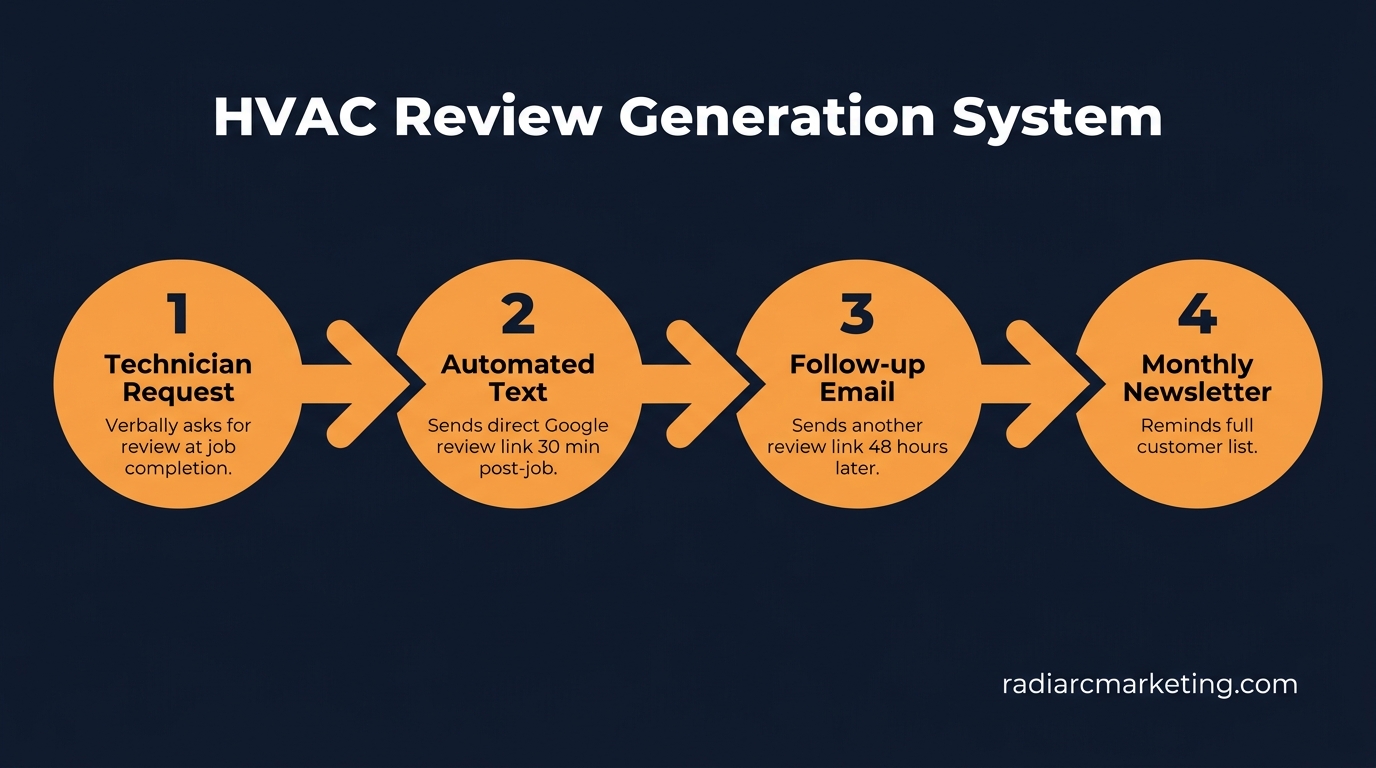
Asking for reviews once at the end of a job is fine, but a system is what separates companies with 30 reviews from companies with 300. A high-performing review generation process looks like this:
- Technician verbally asks for a review at job completion while the customer is still happy
- Automated text message sent 30 minutes after the job with a direct link to your Google review page
- Follow-up email sent 48 hours later with the same link and a personal note from the owner
- Monthly email newsletter to your customer list reminding them that reviews help the business
The goal is to make leaving a review as frictionless as possible. A direct link that opens the review compose screen — not just your Google Business Profile — removes the friction and dramatically increases completion rates.
13. Respond to Every Review — Especially the Negative Ones
Your response to a negative review is often more powerful than the review itself. Potential customers read how you respond to criticism. A calm, professional, solution-oriented response to a 1-star review demonstrates maturity and reliability. It often converts hesitant buyers who were on the fence.
Never argue with a reviewer publicly. If the complaint is legitimate, acknowledge it and outline the steps you’re taking to make it right. If it appears to be a mistake or fake review, politely clarify the facts without being defensive.
14. Build a Referral Program With Real Incentives
Word-of-mouth has always been the HVAC industry’s most powerful lead source, but most contractors leave it entirely to chance. A structured referral program turns random referrals into a repeatable, scalable system.
Effective HVAC referral program structures include:
- Cash or gift card rewards: $50–$100 for every referred customer who books a job over a certain dollar amount
- Service credit: $75 off the referring customer’s next service visit
- Two-sided rewards: both the referrer and the new customer receive a discount (this drives more referrals because the referring customer feels less awkward asking)
- Maintenance plan member perks: members who refer a new customer get a month of their maintenance plan free
Communicate your referral program proactively. Add it to your invoices, post-job thank-you emails, and maintenance plan renewal notices. If your customers don’t know it exists, they can’t participate.
15. Manage Your Presence on Yelp, Angi, and HomeAdvisor
While Google is the primary review platform, a significant portion of homeowners still use Yelp, Angi, and HomeAdvisor when evaluating contractors. Claim and optimize your profiles on each platform, respond to all reviews, and audit your listings quarterly to ensure NAP (name, address, phone) consistency across all directories. Inconsistent information across directories weakens your local SEO and confuses potential customers.
⚠️ Warning: Never purchase fake reviews or offer customers a direct incentive in exchange for a positive review. Google and Yelp both have sophisticated detection systems, and getting caught can result in all your reviews being removed or your profile being penalized — setting your reputation back by years. Earn reviews through exceptional service and frictionless ask processes.
88%
of consumers trust online reviews as much as personal recommendations from friends and family (BrightLocal)
Is Your Review Profile Winning or Losing You Jobs?
Seasonal and Local Marketing Tactics That Fill Slow Months
HVAC is an inherently seasonal business in most markets. Summer is AC repair season; late fall is furnace replacement season; spring and fall are tune-up seasons. The companies that grow year-over-year aren’t just riding the seasonal waves — they’re using slow-season marketing to build the pipeline that fills their trucks when demand drops.
16. Email Marketing: Your Most Underused HVAC Marketing Channel
If you’ve been in business for more than two years and you haven’t been collecting customer email addresses, you’re sitting on a gold mine of untapped revenue. Every customer you’ve ever served is a potential repeat customer, maintenance plan subscriber, and referral source. Email is how you stay in front of them without paying for another ad.
A simple HVAC email marketing calendar might look like this:
- March/April: “Is your AC ready for summer? Schedule your spring tune-up now.”
- June: “Beat the heat — emergency AC repair, same-day service available.”
- September: “Don’t get caught in the cold — furnace inspection specials this month only.”
- November: “Holiday season is coming. Make sure your heating system is ready.”
- January/February: “Upgrade to a new high-efficiency system — 0% financing available through March.”
- Monthly: Newsletter with one helpful tip, one current promotion, and a reminder about your maintenance plan
Tools like Mailchimp, Constant Contact, or ServiceTitan’s built-in email feature make this automation accessible even for small HVAC operations. The key is consistency — one email per month to your entire list keeps you top-of-mind without burning people out.
17. HVAC Maintenance Plans: The Marketing Flywheel
A maintenance plan isn’t just a revenue stream — it’s a marketing asset. Maintenance plan members:
- Are 3x more likely to call you first for repairs vs. shopping around
- Are your best source of online reviews (they know you, trust you, and feel loyal)
- Are your most likely referral sources
- Create predictable recurring revenue that smooths out seasonal cash flow
Market your maintenance plan at every touchpoint: on your website, in post-job follow-up emails, in your trucks, and via seasonal promotions. Framing matters — don’t just sell “a plan,” sell peace of mind, priority service, and guaranteed appointments before the busy season rush.
18. Truck Wraps and Yard Signs: Local Brand Saturation
Don’t underestimate offline marketing. In a tight service area, a professionally wrapped truck driving 80+ miles per day is essentially a mobile billboard generating thousands of impressions. Studies estimate a single wrapped vehicle generates 30,000–70,000 daily visual impressions in dense urban and suburban markets.
Yard signs placed (with permission) at job sites in neighborhoods you’re actively working signal to neighbors that you’re trusted locally. Pair them with a QR code linking to your Google Business Profile for quick review access or a free estimate request form.
19. Community Sponsorships and Local Partnerships
Sponsoring a local little league team, school fundraiser, or community event does two things simultaneously: it builds genuine goodwill in your service area and it generates mentions and backlinks from local websites and social media — both of which improve your local SEO. Partner with complementary trades (electricians, plumbers, roofers, real estate agents) for cross-referral relationships that cost nothing but attention.
💡 Good to Know: HVAC contractors with an active email list of 1,000+ past customers typically generate $15,000–$30,000 in incremental revenue per year from email campaigns alone — without spending a dollar on ads. If you’re not collecting emails at every job, start today.
Building a Long-Term HVAC Marketing System
The difference between HVAC companies that grow year after year and those that stay flat isn’t the quality of their technicians or even their pricing — it’s whether they have a marketing system or just a collection of random tactics. A system is a set of processes that runs consistently, generates data, and improves over time. Tactics are one-off experiments you try when the phone gets quiet.
For a complete framework on how all these channels fit together into a cohesive strategy, Radiarc’s Complete Guide to Growing Your HVAC Business in 2026 walks through the full playbook — from first-year foundations to multi-location scaling strategies.
20. Track Everything With a Marketing Dashboard
You can’t improve what you don’t measure. Every HVAC contractor should be tracking, at minimum:
- Total leads by source: How many calls, forms, and chats came from Google organic, Google Ads, LSAs, Facebook, referrals, and direct traffic?
- Cost per lead by source: What did each lead actually cost you?
- Lead-to-booked-job rate: What percentage of leads are turning into actual jobs?
- Revenue by marketing channel: Which channels are generating the highest-value jobs, not just the most calls?
- Review count and average rating: Weekly tracking of your Google review growth
- Website traffic and conversion rate: Monthly reporting from Google Analytics 4
Most field service software platforms (ServiceTitan, Housecall Pro, FieldEdge) have built-in marketing attribution tracking. Use it. If you’re running Google Ads, install proper conversion tracking so you can see exactly which campaigns and keywords are generating calls — not just clicks.
Prioritizing Your HVAC Marketing Investment
If you’re starting from scratch or reallocating a limited budget, here’s the recommended priority order for implementing these HVAC marketing ideas:
- Google Business Profile optimization — free and highest local impact
- Website conversion optimization — fix your foundation first
- Review generation system — builds trust for all other channels
- Google Local Services Ads — fastest paid path to leads
- Local SEO content — long-term organic traffic engine
- Email marketing to past customers — highest ROI on existing relationships
- Google PPC / Meta Ads — scale once you have conversion tracking dialed in
- Social media and content — brand building and referral amplification
You don’t need to do everything at once. Build one layer at a time, track your results, and reinvest a portion of each successful campaign into the next channel. The HVAC contractors who dominate their markets consistently in 2026 aren’t necessarily spending the most — they’re spending the smartest.
If you’re unsure where to focus first or want an expert audit of your current marketing performance, Radiarc’s HVAC Digital Marketing Ultimate Guide provides the full strategic framework and channel-by-channel breakdowns to help you make data-driven decisions for your specific market and budget.
4.2x
more revenue growth for HVAC companies with documented marketing strategies vs. those running ad-hoc campaigns (ACHR News Industry Study)
Ready to Build a Real HVAC Marketing System?
Frequently Asked Questions
What is the best marketing strategy for an HVAC company?
The best HVAC marketing strategy combines a high-converting website, strong local SEO, an optimized Google Business Profile, and a review generation system as the foundation. Layer Google Local Services Ads on top for fast lead generation, and add email marketing to your existing customer base for consistent repeat business. The key is building these as interconnected systems rather than isolated tactics. Most HVAC contractors see the best ROI by starting with their Google Business Profile and review profile, then investing in SEO content and paid ads as their budget grows.
How much should an HVAC company spend on marketing?
Industry benchmarks suggest HVAC companies should spend 5–10% of gross revenue on marketing, with higher percentages appropriate for companies in growth mode or entering new markets. A typical small HVAC company doing $800,000 in annual revenue might allocate $40,000–$80,000 per year to marketing, which covers website management, SEO, paid ads, and reputation tools. The more important metric than total spend is cost-per-lead and cost-per-acquired-customer — track these religiously to know which channels deserve more investment and which should be cut.
Does social media marketing actually work for HVAC companies?
Social media works for HVAC companies, but not the way most contractors expect. You’re unlikely to get a flood of emergency repair calls directly from Instagram — but consistent social media presence builds brand awareness, demonstrates expertise, and keeps you top-of-mind so that when a follower’s AC breaks, they call you instead of Googling for options. Facebook is most effective for reaching homeowners aged 35–65, while TikTok and Instagram Reels can generate significant organic reach for educational and behind-the-scenes content. Paid social (Meta Ads) works best for promoting maintenance plans and seasonal tune-up specials, not emergency services.
How do I get more HVAC leads without paying for ads?
The best free HVAC lead generation strategies are local SEO, Google Business Profile optimization, and systematic review generation. Regularly posting job photos and updates to your Google Business Profile signals activity to Google’s local ranking algorithm. Publishing blog content targeting specific questions homeowners search (like cost guides and comparison articles) builds organic traffic over time. Building a referral program turns existing customers into lead sources without any ad spend. Email marketing to past customers is another high-ROI free channel — if you have the list. Nextdoor organic posts in local neighborhood groups can also generate direct leads with zero ad budget.
What makes HVAC marketing different from other contractor marketing?
HVAC marketing is unique because demand is largely driven by urgent, unplanned events (equipment failures) and extreme weather, rather than discretionary purchases. This means your marketing needs to be in place and performing before the homeowner has a problem — so when their furnace fails on a cold night, your name is already familiar or you rank first in their panicked Google search. It also means timing matters enormously: seasonal paid ad campaigns, pre-season email promotions, and search ads calibrated to weather events are all levers that don’t exist in other industries. Finally, the trust barrier is high — HVAC work is expensive and involves entering someone’s home, so review count, professional branding, and verified credentials all carry more weight than in lower-stakes service categories.
The Bottom Line
The most successful HVAC contractors in 2026 aren’t necessarily the best technicians — they’re the ones who’ve built reliable marketing systems that generate consistent leads across multiple channels simultaneously. The 20 HVAC marketing ideas in this guide aren’t theoretical; they’re the same strategies that Radiarc deploys for HVAC clients across competitive markets every day.
Start with your foundation: your website, your Google Business Profile, and your review generation process. Add paid channels like Google Local Services Ads once your foundation is solid. Then build the long-game channels — local SEO content, email marketing, and social media — that compound in value over time. Track everything, reinvest in what works, and cut what doesn’t.
The contractors who treat marketing as a system rather than an expense grow their revenue predictably, fill their trucks in slow months, and eventually have more work than they can handle. That’s the goal — and every idea in this guide is a step toward it.
- Audit your Google Business Profile today: verify all information is complete, add 5 new job photos this week, and set up a weekly posting schedule
- Implement a review request text message within 24 hours of every completed job — aim to double your current review count in the next 90 days
- Set up Google Local Services Ads if you haven’t already — it’s the fastest path to qualified HVAC leads with a measurable cost-per-lead
- Build a simple email list by collecting customer emails at every job and send one seasonal promotion email per month to past customers
- Choose one social media platform (Facebook is recommended for most HVAC markets) and commit to posting 3x per week for 90 days before evaluating results