

The Fast Facts
- 97% of consumers search online for local services before calling a contractor
- HVAC companies that invest in SEO see an average 3-5x ROI within 12 months
- Google Local Services Ads generate leads at 30-50% lower cost-per-lead than traditional PPC for HVAC
- 78% of local mobile searches for HVAC services result in a same-day service call
- HVAC contractors with 50+ Google reviews earn 2.7x more clicks than competitors with fewer than 10
Reviewed and fact-checked by Radiarc marketing experts
In this article
- What Is HVAC Digital Marketing? (A Contractor’s Definition)
- Why Traditional Advertising No Longer Works for HVAC Companies
- The HVAC Digital Marketing Funnel: From Stranger to Signed Customer
- HVAC SEO: How to Rank #1 in Your Market
- Google Ads and Local Services Ads for HVAC Contractors
- Social Media, Email, and Reputation Marketing for HVAC
- Building Your HVAC Digital Marketing System: A 90-Day Roadmap
What Is HVAC Digital Marketing? (A Contractor’s Definition)
- Search Engine Optimization (SEO): Getting your website to rank on Google when homeowners search for “AC repair near me” or “furnace replacement [your city].”
- Google Business Profile (Google Maps): Dominating the local 3-pack so your business appears at the top of map results.
- Google Ads & Local Services Ads: Paid campaigns that put your phone number in front of homeowners the moment they’re searching for HVAC help.
- Website Conversion Optimization: Turning website visitors into phone calls and form submissions — because traffic without conversions is just noise.
- Social Media Marketing: Building trust and brand awareness on platforms like Facebook and Nextdoor where homeowners share recommendations.
- Email Marketing: Staying top-of-mind with past customers so they call you for tune-ups, system replacements, and referrals.
- Online Reputation Management: Actively generating Google reviews and managing your ratings to build social proof.
Why Traditional Advertising No Longer Works for HVAC Companies
For decades, HVAC contractors built their businesses on a handful of reliable channels: truck wraps, door hangers, newspaper ads, radio spots, and the all-powerful Yellow Pages listing. And for a long time, it worked. The problem? Consumer behavior has fundamentally changed — and it happened fast. Today, when a homeowner’s AC dies at 9pm on a Saturday, they don’t flip through a phone book. They don’t wait until Monday to ask a neighbor. They pull out their phone and type “emergency AC repair near me” into Google. That search happens in seconds, and within minutes, they’ve already called one of the top three results. If your HVAC company isn’t one of those top three results, you don’t exist in that moment. Here’s what the data shows about the shift in consumer behavior:- 97% of consumers research local service companies online before making contact
- The average homeowner considers fewer than 3 contractors before making a decision — and almost always picks from the first page of Google results
- Print advertising reaches a shrinking audience — newspaper readership has declined by more than 50% in the past decade
- Direct mail response rates for HVAC average 1-2%, while targeted digital ads can achieve 5-10x that performance at comparable cost
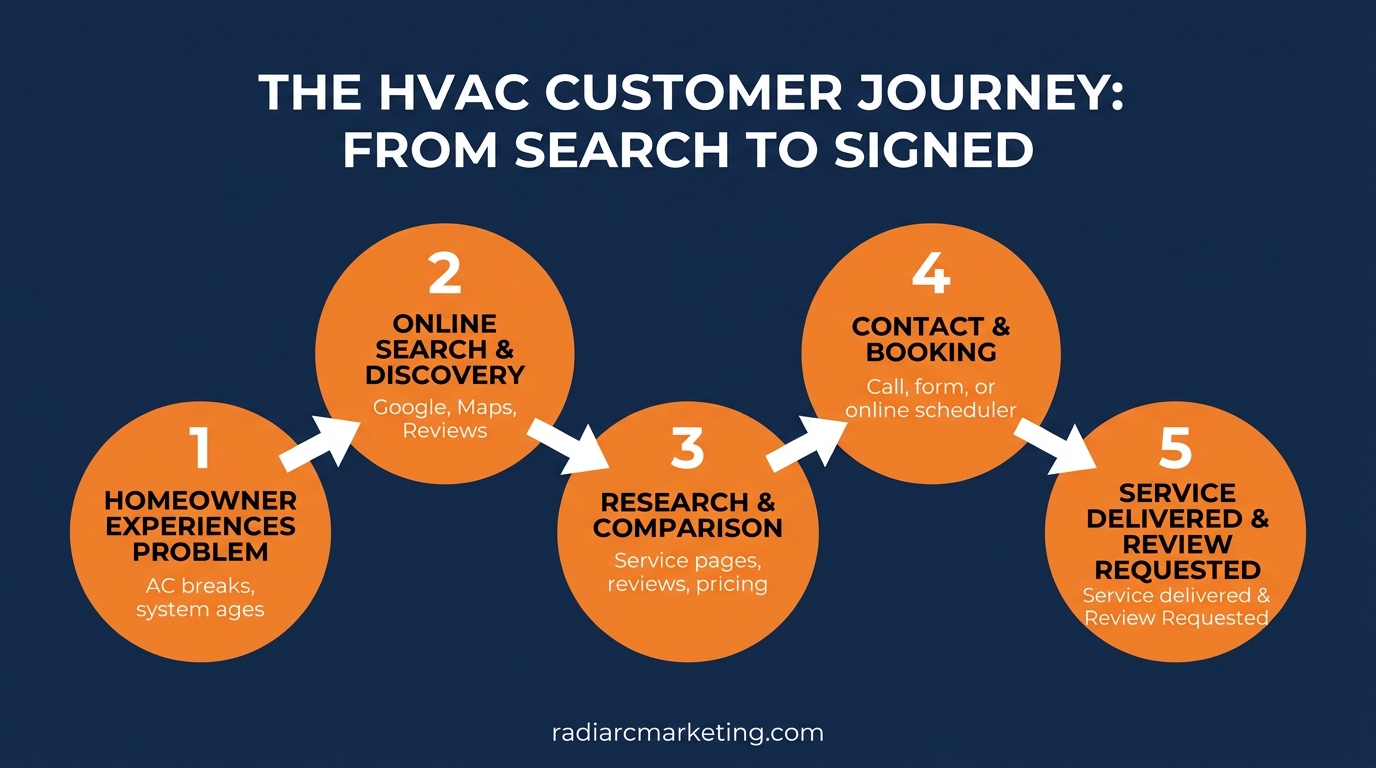
The HVAC Digital Marketing Funnel: From Stranger to Signed Customer
Before you invest a dollar in any marketing channel, you need to understand how HVAC customers actually make decisions online. This is called the marketing funnel — and for HVAC contractors, it looks a little different than it does for e-commerce brands or software companies. HVAC purchases fall into two categories, and each requires a different funnel approach:- Emergency/Reactive Purchases: The AC broke. The furnace won’t turn on. The homeowner needs help TODAY. These customers skip the top of the funnel entirely — they go straight to Google and call the first credible result they find. For these customers, you need to win on Google Ads, Local Services Ads, and Google Maps .
- Planned/Proactive Purchases: The homeowner knows their 18-year-old system is on borrowed time. They’re researching replacement costs, efficiency ratings, and contractor options. They’ll take days or weeks to decide. For these customers, you need SEO, content marketing, and email nurture sequences .
- Top of Funnel (Awareness): Blog content, social media, YouTube videos — building brand visibility with homeowners who aren’t in crisis yet
- Middle of Funnel (Consideration): Service pages optimized for SEO, Google reviews, before/after photos, financing information — helping researching homeowners choose you over competitors
- Bottom of Funnel (Decision): Google Ads, Local Services Ads, click-to-call buttons, online booking — making it effortless to contact you the moment they’re ready
Want a Custom HVAC Marketing Funnel Built for Your Market?
Radiarc builds complete digital marketing systems for HVAC contractors — from SEO and Google Ads to reputation management and lead nurturing. Let’s map out what your business needs.HVAC SEO: How to Rank #1 in Your Market

The Four Pillars of HVAC SEO
1. Technical SEO — Your Website Foundation Before Google can rank your site, it needs to be able to crawl and index it properly. Technical SEO includes site speed (Google’s Core Web Vitals), mobile responsiveness, HTTPS security, clean URL structure, and proper XML sitemaps. An HVAC website that loads in under 2 seconds on mobile converts significantly better than one that takes 5+ seconds — and Google knows this. If your site is slow, you’re losing both rankings and customers. 2. On-Page SEO — Optimizing Your Service Pages Every service you offer should have its own dedicated, optimized page — not just a bullet point on a generic “Services” page. That means individual pages for:- AC Installation and Replacement
- AC Repair and Service
- Furnace Installation and Replacement
- Furnace Repair
- Heat Pump Services
- HVAC Maintenance and Tune-Up Plans
- Indoor Air Quality Services
- Commercial HVAC (if applicable)
- A fully optimized Google Business Profile with accurate NAP (name, address, phone), correct service categories, photos of your team and trucks, and regular Google Posts
- A strong and consistent review profile — actively request reviews after every job and respond to every review, positive or negative
- Local citations — your business listed consistently across directories like Yelp, Angi, HomeAdvisor, BBB, and industry-specific directories
- Location pages on your website for every city and suburb you serve
Google Ads and Local Services Ads for HVAC Contractors
If SEO is the long game, Google Ads and Local Services Ads (LSAs) are the short game — paid traffic that puts your phone number in front of homeowners the moment they’re searching. For HVAC contractors, these are among the highest-converting advertising channels available, but they’re also easy to burn money on if you don’t know what you’re doing.Google Search Ads (PPC) for HVAC
Google Search Ads are pay-per-click ads that appear at the top of search results for keywords you bid on. For HVAC, the most valuable keywords — “AC repair,” “furnace replacement,” “emergency HVAC service” — can cost $15–$65 per click in competitive markets. That’s not cheap. But when a single AC installation generates $4,000–$12,000 in revenue, even a $500 ad spend to land one job is excellent ROI. The keys to profitable HVAC Google Ads:- Match types matter: Use Exact Match and Phrase Match keywords to avoid paying for irrelevant clicks (like someone searching for “HVAC technician jobs” or “DIY AC repair”)
- Negative keywords are critical: Add aggressive negative keyword lists — “jobs,” “DIY,” “free,” “wholesale,” “parts,” “manual” — to block non-buyer traffic
- Ad extensions: Use call extensions, location extensions, and structured snippet extensions to maximize your ad’s real estate and click-through rate
- Landing pages, not homepages: Send ad traffic to dedicated service landing pages, not your homepage. A page specifically designed for “AC Repair in [City]” will convert significantly better than a generic homepage
- Track conversions: Set up call tracking and form submission tracking so you know exactly which keywords and ads are generating actual leads — not just clicks
Local Services Ads (LSAs) — The HVAC Game-Changer
If you’re not running Google Local Services Ads , you’re leaving money on the table. LSAs appear above regular PPC ads in search results, display a “Google Guaranteed” or “Google Screened” badge, and — most importantly — you only pay per lead, not per click. For HVAC contractors, LSA cost-per-lead typically runs $25–$75 , compared to $80–$200+ for traditional PPC leads in competitive markets. To qualify for LSAs, you’ll need to pass Google’s background check process (for yourself and any technicians you list), verify your license and insurance, and build up your Google reviews. The more reviews you have and the higher your response rate to leads, the more aggressively Google will show your LSA listing. Contractors with 100+ reviews and a 4.8+ rating regularly appear in the top two LSA positions — which translates directly to more calls.Bing Ads: The Overlooked Opportunity
Most HVAC contractors ignore Bing, but they shouldn’t. Bing captures roughly 6–8% of U.S. search volume, and importantly, Bing’s user base skews older — which is exactly the demographic most likely to own a home and need HVAC services. Bing Ads (Microsoft Advertising) typically cost 30–50% less per click than Google Ads for the same keywords, with comparable conversion rates. If you’ve maxed out your Google Ads budget, Bing is the next channel to test.Are Your Google Ads Actually Generating Profitable HVAC Leads?
Radiarc audits HVAC Google Ads accounts and identifies exactly where budget is being wasted. Most contractors are shocked by what we find. Book a free audit today.Social Media, Email, and Reputation Marketing for HVAC
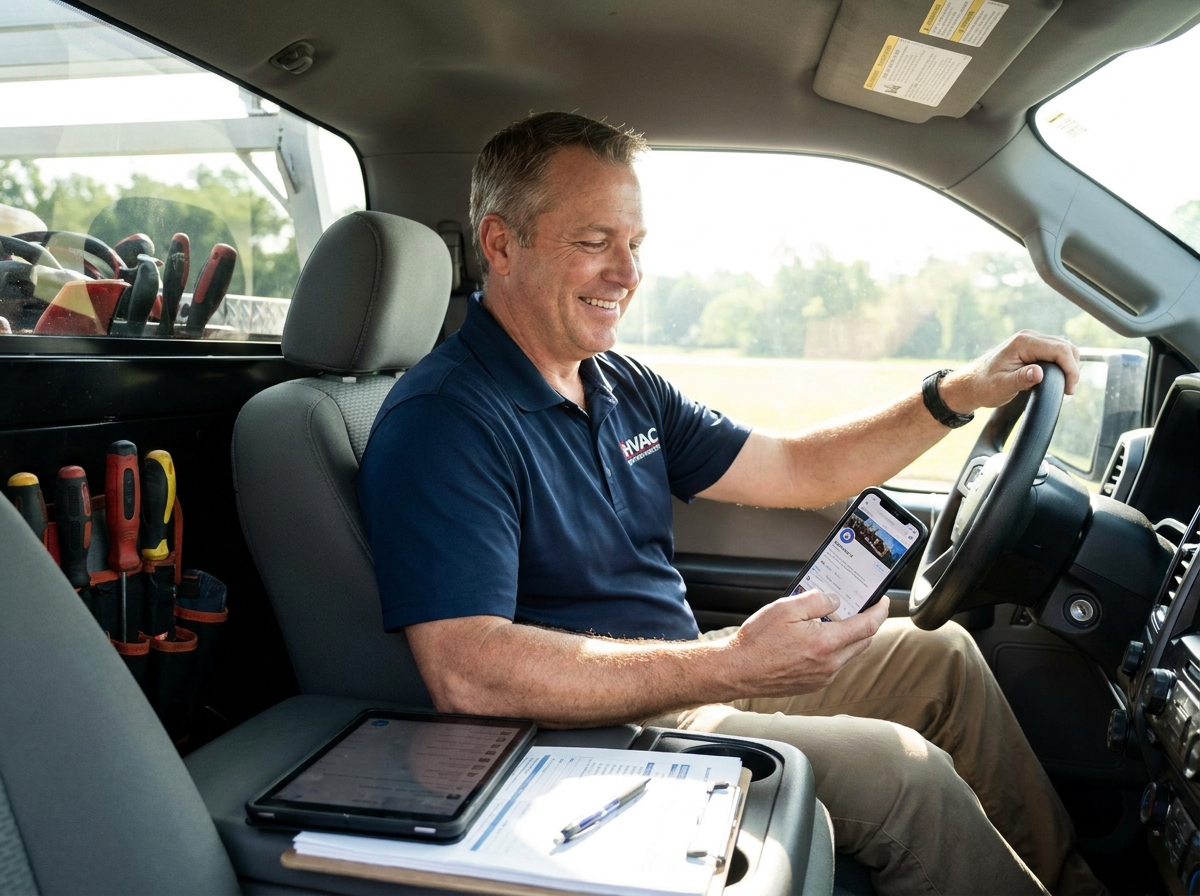
Social Media Marketing for HVAC Contractors
Let’s be real: HVAC isn’t exactly viral content. But that doesn’t mean social media is useless — it means you need to use it strategically. The goal of social media for HVAC isn’t to go viral; it’s to be present and credible when a homeowner in your service area is researching contractors. The platforms that matter most for HVAC:- Facebook: Still the dominant platform for homeowners 35+. Use it for before/after project photos, customer testimonials, seasonal promotions, and community engagement. Facebook ads targeting homeowners in specific zip codes by age and home ownership status can be highly effective for maintenance plan signups and equipment promotions.
- Nextdoor: Arguably the most underused platform in HVAC marketing. Nextdoor is hyperlocal — your business posts literally appear to homeowners in specific neighborhoods. Claim your business page, respond to service recommendations, and post helpful seasonal tips. A single Nextdoor recommendation in a neighborhood can generate 5–10 calls.
- Instagram: Best for visual content — new system installs, equipment photos, team photos, before/after duct cleaning or attic insulation jobs. If your team does quality work, show it.
- YouTube: Long-term investment with compounding returns. Short videos answering homeowner questions (“How often should I change my air filter?” “What does it mean when my AC is leaking water?”) build authority and can rank in both YouTube and Google search results.
Email Marketing: Your Most Profitable Retention Channel
Acquiring a new HVAC customer costs 5–7x more than retaining an existing one. Yet most HVAC contractors never contact their past customers again after the service call. That’s a massive revenue leak. A simple email marketing strategy can recapture thousands of dollars in annual recurring revenue from your existing customer base. An effective HVAC email strategy includes:- Seasonal maintenance reminders: Send a tune-up reminder email in March (before AC season) and September (before heating season) to your full customer list
- Maintenance plan promotions: Email campaigns offering discounted annual maintenance agreements to past service customers
- Equipment replacement outreach: Segment customers by system age and send targeted “is your system due for replacement?” campaigns to those with 10+ year old equipment
- Review request sequences: Automated post-service emails requesting Google reviews — this alone can 3x your review generation rate
Reputation Management: Your Digital Word-of-Mouth
In HVAC, your reputation is everything — and in 2026, your reputation lives online. Google reviews are the single most powerful conversion factor in HVAC digital marketing. A contractor with 150 reviews and a 4.9 rating will out-convert a contractor with 12 reviews and a 4.2 rating every single time, even if the second contractor has a better website and bigger ad budget. To build a dominant review profile:- Make review requests part of every single service call — train your technicians to ask, and send automated follow-up texts/emails through your CRM
- Respond to every review — positive AND negative. A thoughtful, professional response to a bad review often impresses potential customers more than the review itself
- Monitor your reviews on Google, Yelp, Facebook, and industry platforms like Angi and HomeAdvisor regularly
- Never buy fake reviews — Google’s detection algorithms are sophisticated and the penalties (including account suspension) far outweigh any short-term gain
Building Your HVAC Digital Marketing System: A 90-Day Roadmap

Days 1–30: Foundation and Quick Wins
The first month is about building the foundation your marketing system will run on:- Audit your current digital presence: Where does your website rank for your core service keywords? How complete is your Google Business Profile? How many reviews do you have compared to your top 3 competitors? What does your website conversion rate look like? You can’t improve what you haven’t measured.
- Optimize your Google Business Profile: Fill every field completely. Add photos of your trucks, team, and recent jobs. Select the correct primary and secondary business categories. Enable the booking button if you use an integrated scheduling tool. Turn on Q&A and answer the most common homeowner questions proactively.
- Fix your website’s technical issues: Run your site through Google PageSpeed Insights and fix the critical issues. Make sure your site is mobile-friendly, loads under 3 seconds, and has SSL (HTTPS). These are table stakes in 2026.
- Implement call tracking: Set up a call tracking solution (CallRail is the industry standard for HVAC contractors) so you can attribute inbound calls to their source — organic, ads, GBP, etc.
- Launch a review request system: Set up an automated post-service text and email sequence asking customers for Google reviews. Even a simple manual process works — the key is consistency.
Days 31–60: Traffic and Lead Generation
Month two is about turning on the traffic spigot:- Launch Google Local Services Ads: If you haven’t already, apply for LSA verification immediately — the process can take 2–4 weeks. Once live, LSAs are typically the fastest path to cost-effective inbound leads.
- Audit or launch Google Search Ads: If you’re running ads, audit your account for wasted spend (broad match keywords, missing negatives, poorly converting landing pages). If you’re not running ads, start with a focused campaign targeting your highest-value services in your core service area.
- Create or optimize your core service pages: Build out individual, keyword-optimized landing pages for your 5–8 core services. Each page should answer: What is the service? Who needs it? What does it cost? Why should they choose you?
- Publish your first 2 blog posts: Pick two questions your customers ask most frequently and write genuinely helpful, detailed answers. These seed your content marketing effort and start building topical authority with Google.
Days 61–90: Compounding and Systemizing
Month three is about compounding your early wins into sustainable systems:- Build your email list and send your first campaign: Export your customer database from your CRM or service software, clean it up, and send a seasonal maintenance email. Even a basic email newsletter platform like Mailchimp or Klaviyo works well for HVAC contractors starting out.
- Establish social media consistency: Commit to a sustainable posting cadence — even 2–3 posts per week on Facebook and Nextdoor makes a meaningful difference. Use photos from real jobs (with customer permission), not stock images.
- Set up monthly reporting: Know your numbers: organic search rankings, website traffic, ad spend, cost-per-lead by channel, and total leads generated. Review these monthly and make data-driven adjustments.
- Build citation consistency: Audit and correct your business listing across the top 20–30 online directories. Inconsistent NAP data hurts your local SEO rankings and confuses potential customers.
Should You DIY or Hire an HVAC Marketing Agency?
This is the question every contractor eventually faces. The honest answer: most HVAC contractors should hire a specialist agency for at least the technical and paid advertising components of their digital marketing. Here’s why:- Google Ads mismanagement can burn through $2,000–$5,000/month in wasted spend before you realize something is wrong
- SEO mistakes (duplicate content, incorrect schema markup, thin service pages) can actively hurt your rankings and take months to recover from
- The time you spend trying to figure out marketing is time you’re not spending on operations, sales, or service delivery
Ready to Build a Real HVAC Digital Marketing System?
Radiarc Marketing specializes exclusively in HVAC and electrical contractors. We don’t work with restaurants, law firms, or dentists — just contractors who want to dominate their local market online. Let’s talk about what your market looks like and what it would take to own it.Frequently Asked Questions
How much should an HVAC company spend on digital marketing?
Most HVAC contractors should allocate 5–10% of their gross revenue to marketing, with digital channels making up the majority of that budget. For a contractor doing $500,000 in annual revenue, that’s $25,000–$50,000 per year — or roughly $2,000–$4,000 per month. Newer or faster-growing companies often invest more aggressively (10–15%) to build market share. Within your digital budget, a typical allocation might be 40% to paid ads (Google Ads + LSAs), 35% to SEO and website, and 25% to content, social, and email. Always track cost-per-lead by channel and reallocate toward what’s working.
How long does HVAC SEO take to show results?
HVAC SEO is a long-term investment — most contractors see meaningful ranking improvements in 3–6 months for lower-competition keywords (like specific service + city combinations) and 6–12 months for highly competitive terms like ‘AC repair [major city].’ However, technical improvements and Google Business Profile optimization can show results much faster — sometimes within 30–60 days. The key is to start SEO now while running Google Ads to generate immediate leads, so you’re not waiting 12 months for the phone to ring. Over time, as your organic rankings improve, you can gradually reduce your dependence on paid ads and lower your overall cost-per-lead significantly.
Are Google Local Services Ads worth it for HVAC contractors?
Yes — Google Local Services Ads are consistently one of the highest-ROI digital advertising channels for HVAC contractors. Unlike traditional PPC where you pay per click (whether or not it becomes a lead), LSAs charge you only when someone actually contacts you through the ad. Average cost-per-lead for HVAC LSAs runs $25–$75, compared to $80–$200+ for regular Google PPC leads in competitive markets. The main requirements are passing Google’s background check, maintaining a strong review profile, and responding to leads promptly. Contractors who respond to LSA leads within 5 minutes see significantly higher conversion rates than those who wait hours or days.
What’s the most important digital marketing channel for HVAC companies?
If you could only invest in one channel, Google Business Profile (Google Maps) optimization is arguably the highest-leverage starting point for most HVAC contractors — it’s free, drives both organic and map-pack visibility, and directly influences both LSA performance and local SEO rankings. That said, the most successful HVAC contractors don’t rely on any single channel. The combination of a well-optimized Google Business Profile, a website built for SEO, and Google Local Services Ads creates a powerful foundation that covers both immediate lead generation and long-term brand building. Think of these three as your core marketing infrastructure.
How do HVAC companies get more Google reviews?
The most effective way to generate Google reviews consistently is to make it a standard part of your post-service process — not an afterthought. Train every technician to ask satisfied customers for a review before leaving the job site, and send an automated follow-up text and email within 2–4 hours of completing a job (when the positive experience is freshest). Keep the ask simple: include a direct link to your Google review page so customers don’t have to navigate to find it. HVAC contractors using this approach consistently report generating 20–40 new reviews per month. Never buy fake reviews or incentivize customers with discounts in exchange for reviews — both violate Google’s policies and risk your account being penalized or suspended.
The Bottom Line
HVAC digital marketing in 2026 is no longer optional — it’s the difference between a business that grows predictably and one that lives and dies by word-of-mouth and seasonal luck. The contractors dominating their local markets have built real systems: a technically sound website that ranks on Google, an optimized Google Business Profile that owns the maps, Local Services Ads generating calls at a profitable cost-per-lead, and a review and reputation engine that makes them the obvious choice. These aren’t overnight projects — they’re 6–18 month investments that compound into lasting competitive advantages. The most important thing you can do right now is take an honest audit of where your business stands digitally. How do you rank for your core services? How does your review count and rating compare to your top competitors? Are your Google Ads actually generating profitable leads, or is budget being wasted on irrelevant clicks? Are you doing anything to market to your existing customer base? Most HVAC contractors who ask these questions honestly discover significant gaps — and significant opportunities. Whether you’re just starting to invest in digital marketing or looking to upgrade an underperforming strategy, the framework in this guide gives you a clear picture of what a winning system looks like. The next step is implementation — and doing it right is worth more than doing it fast.- Audit your Google Business Profile today — make sure it’s 100% complete, has current photos, and has the correct primary category (Heating Contractor or Air Conditioning Contractor)
- Compare your Google review count and rating to your top 3 local competitors — if you’re behind, implement a post-service review request system this week
- Run your website through Google PageSpeed Insights and identify your top 3 technical issues affecting load speed and mobile performance
- Check whether you’re running Google Local Services Ads — if not, start the verification process today, as it takes 2–4 weeks
- Calculate your current cost-per-lead by channel — if you don’t know this number, set up call tracking immediately so you can make data-driven marketing decisions