
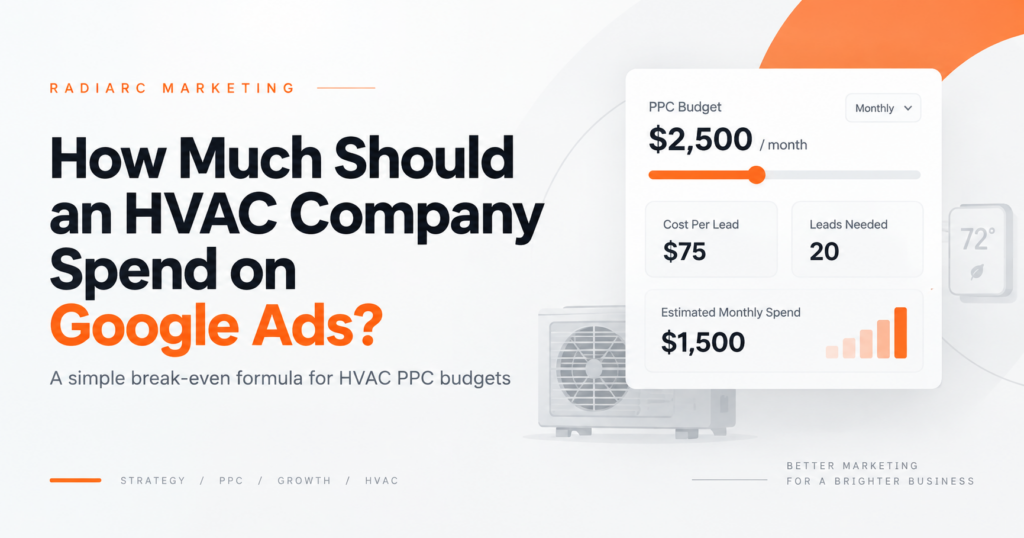

If you’re trying to decide how much your HVAC company should spend on Google Ads, starting with an arbitrary monthly budget is backwards.
“$1,500 a month sounds reasonable” doesn’t tell you whether the advertising can actually make money.
A better question is:
How much can your HVAC company afford to pay to acquire a new customer?
Once you know that number, you can work backward into a maximum cost per lead and then into an advertising budget.
That’s what we’re going to calculate here.
Quick answer
There isn’t one correct Google Ads budget for every HVAC company.
A company selling $12,000 system replacements can afford to acquire customers differently than a company advertising $129 tune-ups.
Your Google Ads budget should be based on four numbers:
- Average revenue from the job you’re advertising
- Gross margin on that work
- Percentage of gross profit you’re willing to spend acquiring the customer
- Percentage of qualified leads that become customers
With those numbers, you can calculate how much a lead is actually worth to your business.
Don’t start with the monthly budget
A lot of HVAC companies approach PPC like this:
“Let’s put $2,000 into Google and see what happens.”
That’s easy, but it doesn’t give you anything to judge the campaign against.
Imagine two campaigns each spend $2,000.
Campaign A
- Generates 20 leads
- Produces 5 customers
- Average job: $450
Campaign B
- Generates 10 leads
- Produces 3 customers
- Average job: $8,000
Campaign A generated twice as many leads.
That doesn’t automatically make it better.
The economics of the jobs are completely different.
Instead of asking how many leads Google produced, start by figuring out what you can afford to pay for a customer.
Step 1: Calculate gross profit per job
Start with the type of HVAC work you’re actually advertising.
Use:
Average job revenue × gross margin = gross profit per job
For example, suppose you’re advertising AC repair.
These numbers are only an example:
| Metric | Example |
|---|---|
| Average repair invoice | $850 |
| Gross margin | 50% |
| Gross profit | $425 |
That means an average completed repair contributes approximately $425 in gross profit before overhead and other expenses.
Notice that we’re not treating the entire $850 invoice as available marketing money.
That’s an important distinction.
Step 2: Decide how much gross profit you’re willing to spend acquiring the customer
Now decide what portion of that gross profit you’re willing to use for customer acquisition.
Suppose the company above is comfortable spending 35% of its gross profit acquiring a new repair customer.
The calculation becomes:
$425 × 35% = $148.75
That means the company’s target customer acquisition cost is approximately:
$149 per new customer
This isn’t an HVAC industry benchmark.
It’s simply the economics of this hypothetical business.
Your number may be dramatically different.
Step 3: Calculate your maximum cost per lead
A lead isn’t the same thing as a customer.
Some people won’t answer their phone.
Some will call three contractors.
Some will decide not to repair the system.
Some will book with you.
That means we need your lead-to-customer close rate.
Let’s assume the HVAC company converts 40% of qualified advertising leads into paying customers.
Use this formula:
Target customer acquisition cost × close rate = target cost per lead
Using our example:
$148.75 × 40% = $59.50
So our hypothetical HVAC company could target approximately:
$60 per qualified lead
Now we finally have a number that can help us evaluate Google Ads.
If we’re consistently buying qualified leads for $40, the economics may look good.
If we’re paying $140, something has to change.
HVAC Google Ads break-even worksheet
You can calculate this for your own company.
| Input | Your Number |
|---|---|
| Average job revenue | $_____ |
| Gross margin | _____% |
| Gross profit per job | $_____ |
| Acquisition percentage | _____% |
| Target acquisition cost | $_____ |
| Lead-to-customer close rate | _____% |
| Target cost per lead | $_____ |
The formulas are:
Gross profit per job
Average job revenue × gross margin
Target acquisition cost
Gross profit per job × acquisition percentage
Target cost per lead
Target acquisition cost × close rate
This is much more useful than choosing a budget because another HVAC company told you what they spend.
Now calculate the monthly Google Ads budget
Once you know what a lead can cost, you can work backward from the number of customers you want.
Suppose you want:
20 additional repair customers per month
And you close:
40% of qualified leads
Calculate required leads:
20 ÷ 0.40 = 50 leads
If you believe you can generate those leads for an average of $50:
50 leads × $50 = $2,500
Your starting advertising budget would be approximately:
$2,500 per month
If leads actually cost $75, the same 50 leads require approximately:
$3,750
That’s why asking, “What’s a good HVAC Google Ads budget?” without discussing unit economics doesn’t make much sense.
The budget is an output.
It shouldn’t be the first input.
How much can you afford to spend on Google Ads?
Enter your company’s numbers below. We’ll calculate your target customer acquisition cost, cost per lead and estimated monthly ad budget.
Service calls and installations should not share the same math
This is where HVAC advertising gets more interesting.
Consider these three searches:
- AC repair near me
- HVAC maintenance
- New AC system installation
They’re all HVAC leads.
Financially, they’re not remotely identical.
An installation customer may support a much higher acquisition cost than a maintenance customer.
That means we generally don’t want one universal rule such as:
“Never pay more than $75 for an HVAC lead.”
That number could be terrible for one service and outstanding for another.
Instead, calculate your economics separately for important service categories.
For example:
| Service | Avg. Revenue | Gross Margin | Target CAC | Close Rate | Target CPL |
|---|---|---|---|---|---|
| Maintenance | Your data | Your data | Calculated | Your data | Calculated |
| Repair | Your data | Your data | Calculated | Your data | Calculated |
| Replacement | Your data | Your data | Calculated | Your data | Calculated |
Use your own numbers.
That’s where this becomes useful.
Your close rate can matter as much as your advertising
Here’s something that often gets overlooked.
Suppose two HVAC companies receive the exact same leads for the exact same price.
Each gets 50 leads at $60.
Both spend:
$3,000
Company A closes 20% of those leads.
That’s:
10 customers
Customer acquisition cost:
$300
Company B closes 40%.
That’s:
20 customers
Customer acquisition cost:
$150
Same Google Ads account.
Same media spend.
Same cost per lead.
Half the customer acquisition cost.
The difference happened after the lead came in.
That means improving your PPC results doesn’t always mean changing keywords, bids or landing pages.
Sometimes the biggest problem is:
- Calls going unanswered
- Slow callbacks
- Poor scheduling
- Weak phone handling
- No follow-up
- Booking friction
Advertising and operations eventually collide.
Don’t confuse a cheap lead with a good lead
Reducing cost per lead can look fantastic inside an advertising dashboard.
It can also make the business less money.
Suppose Campaign A generates leads for $40 and Campaign B generates leads for $80.
The obvious reaction is to move money into Campaign A.
But now look at sales:
Campaign A
- 50 leads
- $40 CPL
- 10% become customers
Spend: $2,000
Customers: 5
CAC: $400
Campaign B
- 25 leads
- $80 CPL
- 40% become customers
Spend: $2,000
Customers: 10
CAC (customer acquisition cost): $200
Campaign B has twice the cost per lead and half the customer acquisition cost.
That’s why an HVAC company’s advertising report shouldn’t stop at:
Clicks → Leads
The useful measurement is:
Spend → Lead → Booked Job → Sold Job → Revenue
Should a new HVAC company start with a small Google Ads budget?
There’s nothing inherently wrong with starting small.
The problem is starting so small that you don’t collect enough information to make decisions.
Imagine spending $300 and receiving four leads.
One closes.
Was the campaign good?
Maybe.
Or maybe you got lucky.
Four leads aren’t much evidence.
A useful testing budget needs to purchase enough actual traffic and leads to begin answering questions such as:
- Which services generate qualified inquiries?
- Which searches produce junk?
- Which geographic areas convert?
- Which landing pages convert?
- What percentage of leads become booked calls?
- What percentage ultimately produce revenue?
If your available budget can’t generate enough activity to answer those questions, extending the test period can be more sensible than expecting a definitive answer in a week.
Don’t advertise every HVAC service on day one
Another mistake is spreading a limited budget across too many services.
A contractor might try to advertise:
- AC repair
- Heating repair
- Maintenance
- Ductwork
- Indoor air quality
- Mini splits
- Commercial HVAC
- System replacements
with one modest budget.
Now every campaign is starving for data.
For a smaller account, I’d rather start with a service where:
Demand exists + economics make sense + the company wants more of that work.
Learn from that campaign.
Then expand.
What Makes an HVAC Lead Qualified?
Not every phone call, form submission, or chat message should count as a qualified lead.
A qualified HVAC lead is a real prospective customer who has a service need your company can actually handle and is located within the area you serve.
That sounds obvious, but this is where PPC reporting can get misleading.
If Google Ads generates 30 conversions, that doesn’t necessarily mean you received 30 legitimate sales opportunities.
Some of those “leads” may be:
- Job applicants
- Vendors trying to sell you something
- Spam calls
- Existing customers calling about an old invoice
- People outside your service area
- Customers looking for a service you don’t provide
- Accidental calls
- Repeated calls from the same person
Those shouldn’t be treated the same as someone calling because their AC stopped working and they want a technician.
A simple definition of a qualified HVAC lead
For our purposes, I’d consider a lead qualified when it meets these basic criteria:
| Question | Qualified? |
|---|---|
| Is the person a potential customer? | Yes |
| Are they located inside your service area? | Yes |
| Do they need a service you offer? | Yes |
| Is there a legitimate opportunity to book the job? | Yes |
| Is it a duplicate, spam call, vendor, or job seeker? | No |
A lead doesn’t have to become a customer to be qualified.
That distinction matters.
Someone can call for AC repair, live inside your service area, need exactly what you offer, and still choose another contractor.
That was still a legitimate lead.
The advertising generated an opportunity. Your company simply didn’t close it.
Qualified lead vs. booked appointment vs. customer
These are three different stages.
Qualified lead
A legitimate prospective customer with a relevant service need.
Booked appointment
A qualified lead who schedules a service call, estimate, or consultation.
Customer
A lead who ultimately purchases from your company.
Keeping those stages separate makes your numbers much more useful.
For example:
50 qualified leads
↓
35 booked appointments
↓
30 completed appointments
↓
18 paying customers
Now you can see where the actual problem is.
If you’re generating plenty of qualified leads but few appointments, the issue may be call handling or scheduling.
If appointments are strong but very few jobs sell, the problem may be pricing, sales, technician performance, or lead quality.
If hardly any of the inquiries are qualified in the first place, then the advertising campaign itself deserves a closer look.
Don’t let Google decide what counts as a lead
A conversion inside Google Ads is only whatever you’ve configured Google to count.
That could be:
- A phone call
- A contact form
- A booking
- A button click
- A chat interaction
Those actions are useful for tracking, but they aren’t automatically qualified leads.
The business should decide what actually counts.
That’s why your advertising report should eventually distinguish between:
Raw conversions → Qualified leads → Booked appointments → Customers
That gives you a much clearer picture than simply saying:
“Google Ads generated 42 leads.”
The better question is:
How many legitimate sales opportunities did those ads actually create?
What numbers should an HVAC company track?
If you’re spending money on Google Ads, these are the numbers I’d want available:
Advertising spend
The actual amount paid to Google.
Qualified leads
Not every form submission or call.
Actual prospective customers.
Booked appointments
How many leads turned into scheduled opportunities?
Completed appointments
How many actually happened?
Sold jobs
This is where advertising turns into customers.
Revenue
How much revenue came from those customers?
Gross profit
Revenue without margin tells only part of the story.
Customer acquisition cost
Use:
Advertising spend ÷ new customers acquired
Lead-to-customer rate
Use:
Customers ÷ qualified leads
Once those numbers are connected, deciding whether to increase or decrease an advertising budget gets considerably easier.
When should you increase the budget?
Don’t increase your Google Ads budget just because Google says the campaign is “limited by budget.”
Increase it when the business economics justify it.
For example:
- Leads are qualified
- Calls are being answered
- Sales can be attributed back to advertising
- Customer acquisition cost is acceptable
- The company has capacity for additional work
If spending $3,000 reliably produces profitable customers, then you have something worth considering scaling.
If you can’t determine whether the original $3,000 produced profitable work, increasing the budget only increases the size of the unknown.
When should you reduce the budget?
Reducing spend can make sense when:
- Lead quality is consistently poor
- Acquisition cost exceeds what the jobs can support
- The company can’t answer or service incoming leads
- Tracking isn’t reliable
- A campaign is generating activity without revenue
But don’t shut a campaign off simply because one metric looks expensive.
Follow the lead all the way through to the sale first.
The simple HVAC PPC budget formula
Here’s the entire process condensed:
1. Calculate gross profit per job
Average job revenue × gross margin
2. Set an acceptable customer acquisition cost
Gross profit × percentage you're willing to invest in acquisition
3. Calculate target cost per lead
Target acquisition cost × lead-to-customer rate
4. Determine how many leads you need
Desired new customers ÷ close rate
5. Estimate the required advertising budget
Required leads × expected cost per lead
Now your Google Ads budget is based on your business rather than somebody else’s opinion.
Final thought
There is no magic monthly Google Ads number that makes sense for every HVAC contractor.
A $10,000 monthly budget can be irresponsible if nobody knows whether the leads become profitable customers.
A $2,000 budget can be too conservative if a company has proven that every additional dollar consistently produces profitable work.
Start with the economics.
Figure out what a customer is worth, what you can afford to pay for that customer, how well your company converts leads into jobs, and how many additional jobs you actually want.
Then build the advertising budget.
About Radiarc Marketing
Radiarc Marketing helps home-service contractors build marketing systems around measurable business outcomes rather than vanity metrics.
If you’re evaluating Google Ads for your HVAC company, our HVAC marketing services and PPC management pages explain how we approach lead generation, conversion tracking and campaign performance.